
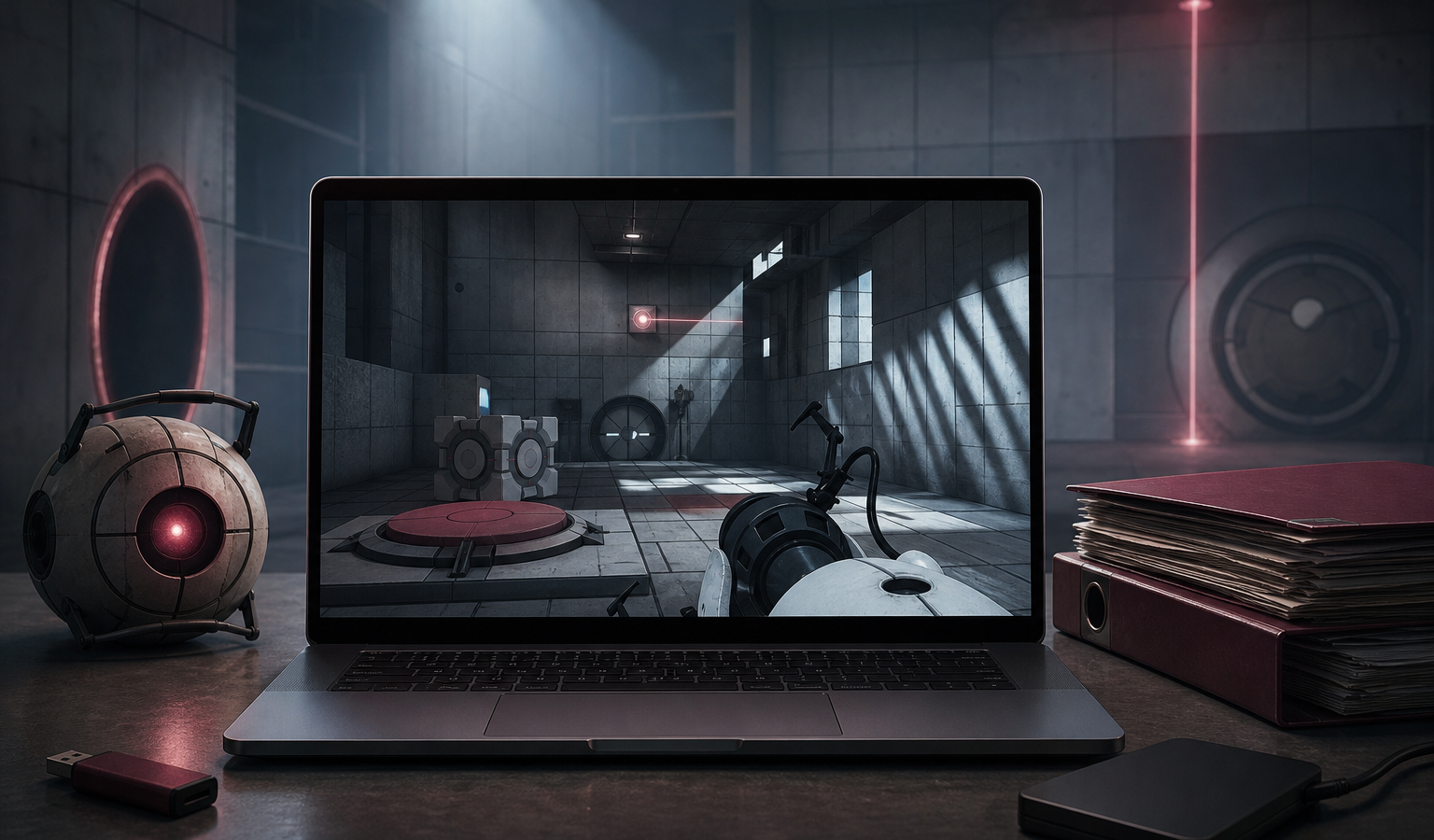
The canceled Portal prequel F-Stop has resurfaced in a form that fans can actually play. According to reports, leakers have compiled assets and later missing pieces into a nearly complete version of the game, offering the closest thing to a release that is likely to exist. What was once only a rumor and scattered leak material is now presented as something close to a finished build, even if it remains unofficial.
The development history and the leak trail together make F-Stop especially notable among canceled games. Instead of remaining a pile of disconnected files, the project has been assembled into a version that can be experienced directly. For fans of Valve’s puzzle series, that gives the project a new relevance, not as an abandoned idea locked in old archives, but as something that can be played and studied in its reconstructed form.
How the playable build came together
The project draws heavily from a massive 12-terabyte leak that surfaced in August, which provided many of the game’s assets but not its source code or map data. Those final components reportedly appeared later in the Valve Cut Content Discord, giving fans enough material to piece together a playable build. In other words, the first leak supplied much of the raw content, while the later additions completed the technical structure needed to make the game run.
Engadget describes the result as a rough version and says it is the closest thing to a release that will be seen. The Verge reports that the assembled build is fully playable and that it was made possible after the additional source code and map data surfaced. Taken together, those reports paint a picture of a project that is not merely preserved, but transformed into something interactive through the combination of multiple leak sources.
The significance of that process is hard to ignore. A game that was never meant to reach players in any official capacity has instead been reconstructed through community effort and leaked material. The result is not a conventional release, but it does provide a practical way to experience content tied to a long-canceled project. For a title as closely associated with Portal as F-Stop, that is enough to make the build stand out on its own.
What F-Stop was supposed to be
F-Stop was developed as a Portal prequel, but it differs significantly from the mainline Portal games. Its central mechanic was built around a camera system that let players capture an item by taking its picture and then place it elsewhere using the resulting Polaroid. Some dialog and elements from F-Stop eventually made their way into Portal 2.
That design idea sets F-Stop apart from the gameplay people normally associate with Portal. Rather than focusing on the familiar structure of the released games, the prequel centered on a photographic mechanic that turned images into interactive tools. Because of that, the playable build offers more than just another look at a canceled game; it also shows an alternate approach to the Portal formula that was at one point far enough along to leave traces in a later release.
The connection to Portal 2 also adds to the game’s importance. Since some dialog and elements from F-Stop ended up in the later game, the leak provides a way to compare the older concept with what ultimately shipped. That makes the compiled build useful not only as a curiosity, but also as a reference point for understanding how ideas moved between projects in Valve’s history.
Why the leak matters
For fans of Valve’s puzzle series, the playable build offers a rare look at a canceled project that never reached an official release. Instead of only seeing fragments, players can now experience a version assembled from leaked material and compare its ideas with the mechanics that appeared later in Portal 2. This makes the build more than a technical novelty; it becomes a way to revisit a missing part of the series’ development history.
The story also highlights how large leaks can preserve pieces of unfinished games long after cancellation. In this case, the combination of assets, source code, and map data was enough to turn scattered material into something interactive. That process demonstrates how unfinished projects can survive in altered form, even when no publisher ever intended them to be made available to the public.
For preservation-minded fans, that matters because it turns inaccessible material into something that can be examined firsthand. Rather than relying solely on descriptions, screenshots, or partial files, people interested in Valve history can now engage with a compiled build and see how the game functions. In the context of a canceled prequel, that is a rare opportunity.
Conclusion
F-Stop may never have arrived as an official game, but the leak-driven build gives it a second life. For anyone interested in Valve history or the evolution of Portal’s ideas, the compiled version provides a playable glimpse at a project that otherwise would have remained a rumor. It stands as both a recovered artifact and a reminder of how much of game development can remain visible, even after cancellation.
In that sense, the story of F-Stop is now about more than a lost prequel. Thanks to the combination of leaked assets, source code, and map data, it has become a playable example of how unfinished projects can reappear in public view. Whether seen as preservation, reconstruction, or simply an unusual leak event, the build offers a concrete way to explore a chapter of Portal history that was never meant to be complete.