
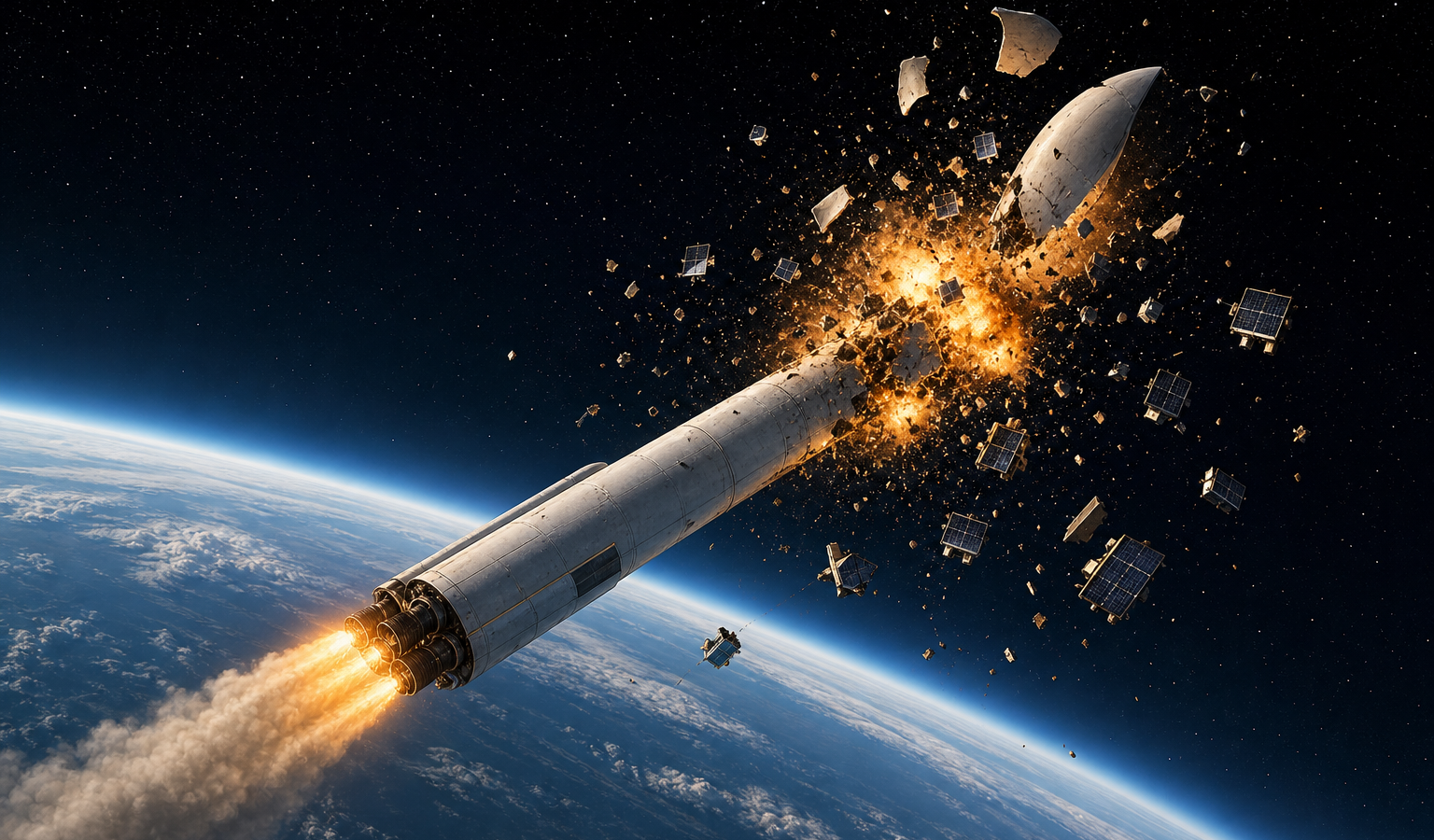
United Launch Alliance’s Vulcan rocket suffered a serious setback during a mission carrying 40 Amazon Leo satellites, with reports indicating the vehicle experienced an anomaly about 10 minutes into the flight. The launch was meant to send Amazon’s broadband satellites toward orbit, but instead it ended in failure and prevented the payload from reaching its intended destination. The incident quickly became significant not only because of the number of satellites involved, but also because of what it meant for both Amazon’s satellite strategy and ULA’s newer rocket program.
Vulcan is part of United Launch Alliance’s push to modernize its launch fleet, and this mission was meant to demonstrate that progress in a high-profile way. Instead, the flight ended with the vehicle failing to complete its assignment, leaving the 40 satellites unreached in orbit. The launch therefore shifted from a routine milestone into a setback that drew attention across the spaceflight industry.
What happened during the launch
According to reports, the Vulcan vehicle lifted off from Space Launch Complex 41 before the problem occurred roughly 10 minutes after launch. United Launch Alliance said in a statement posted on X that data received by its Launch Director confirmed the anomaly. The mission did not complete successfully, and the 40 satellites aboard were lost from the intended deployment path.
The details supplied in the reporting focus on the timing and confirmation of the anomaly rather than on a technical explanation. ULA’s statement, as described, established that the flight was no longer proceeding as planned. The supplied reporting does not include additional technical details about the cause of the failure, so the available facts remain limited to the confirmed anomaly and the unsuccessful outcome of the mission.
The launch carried Amazon Leo satellites, part of Amazon’s broadband satellite effort and a competitor to SpaceX’s Starlink. The flight was described as the first of 38 launches Amazon purchased from ULA, making the failed mission an important early step in that partnership. That context gives the launch added weight: it was not simply a single delivery attempt, but the opening flight in a larger contracted launch campaign.
Why this mission mattered
The Vulcan rocket is one of United Launch Alliance’s newest vehicles, and the failure is being described as a major blow to the company’s early track record with the system. ULA has long been associated with reliability, especially through its Atlas V rocket, so this mission failure stands out as a notable exception. That reputation makes the outcome especially striking, because the launch represented one of the key moments in the company’s transition to a newer platform.
For Amazon, the setback affects a project that has struggled to build up the satellite presence needed to compete more directly with Starlink. Reports say that only a small portion of the required satellites had reached orbit before this launch attempt, so the loss of 40 more satellites is a significant delay for the program. The failed launch therefore does more than interrupt one mission; it slows a broader effort to expand the constellation needed for Amazon’s broadband ambitions.
In practical terms, the mission’s failure means the planned satellite deployment did not happen as intended. Because this flight was the first of 38 Amazon purchased from ULA, it was intended to help launch a larger sequence of missions. Instead, the lost payload leaves the partnership with an early complication that will likely need to be addressed before the launch schedule can move forward smoothly.
What ULA said
ULA said that the Vulcan vehicle suffered an anomaly during the mission, based on telemetry received by the Launch Director. That statement confirmed the flight was no longer proceeding as planned, though the supplied reporting does not include additional technical details about the cause of the failure. The company’s confirmation centers on the timing of the issue and the fact that the vehicle was launched from Space Launch Complex 41 before the anomaly was detected.
The incident is notable because it reportedly marks the first mission failure in ULA’s 20-year history. That makes the launch especially significant not only for Amazon’s satellite plan, but also for the launch provider’s broader reputation. A failure of this kind is therefore unusual within the context of ULA’s history, and it places the Vulcan program under immediate scrutiny.
Given ULA’s long association with reliable launches, especially through Atlas V, the failure of Vulcan is particularly noteworthy. It creates a contrast between the company’s established record and the outcome of this newer vehicle’s mission. The reporting supplied here does not go beyond that contrast, but it does make clear that the launch will be remembered as an important and disappointing moment for the company.
Conclusion
The failed Vulcan launch represents a sharp setback for both United Launch Alliance and Amazon’s satellite ambitions. A mission that was supposed to begin a major launch campaign ended with an anomaly shortly after liftoff, leaving 40 Amazon Leo satellites unreached in orbit and raising immediate questions about the rocket’s early operational record.
For Amazon, the failure interrupts a broadband satellite effort that is meant to compete with SpaceX’s Starlink. For ULA, it is a damaging moment for a newer rocket system and, according to the supplied reporting, the first mission failure in its 20-year history. Taken together, those facts make the launch one of the most consequential early events in the Vulcan program and an early obstacle in Amazon’s larger satellite deployment plan.